Why your engineering team gets slower as it grows
Growth slows delivery for a measurable reason: coordination between coupled parts. Here is what that costs and how to put a number on it.
October 30, 2026 · Article 1
Blog
Growth slows delivery for a measurable reason: coordination between coupled parts. Here is what that costs and how to put a number on it.
October 30, 2026 · Article 1
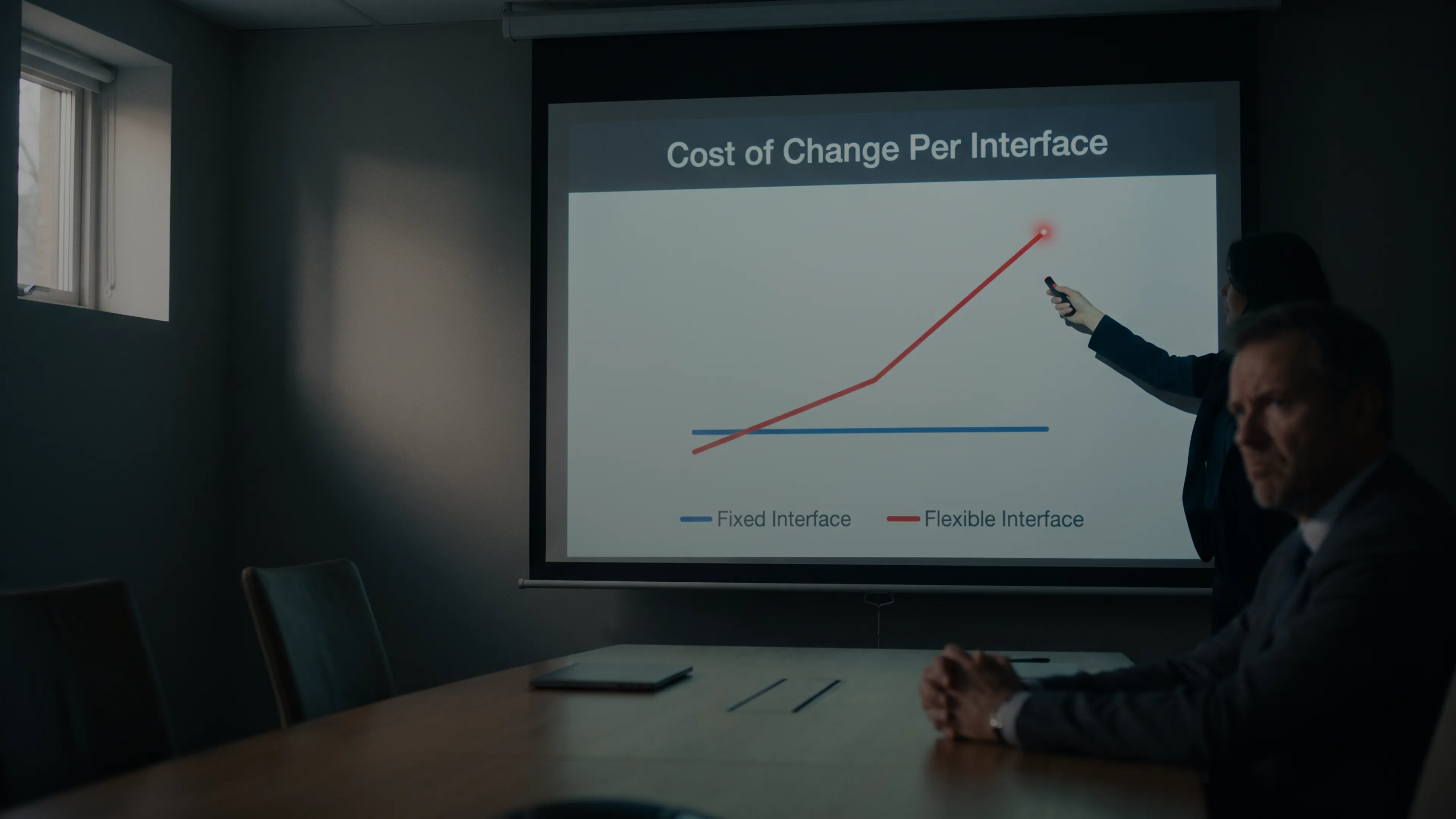
A 40-hour feature takes 464 hours when twelve modules move with it. The calculator returns 11.60x and $69,600 for that feature.
October 30, 2026 · Article 2
A team extracted a billing module from a monolith six months ago. They are still running both systems, and the sync layer between them is consuming more budget than either platform. The next article gives you the formula to see exactly why that parallel state costs three times what the estimates predicted, and the one leadership decision that turns a permanent trap into a finished project.
October 26, 2026 · Article 19
You approved a feature that came in nearly double the estimate because the cost of what it broke never showed up in the budget. The next article builds a single multiplier from your regression rate and incident cost, using the same logic insurers use to price risk, converting any build estimate into the true cost including everything your change breaks. One number that turns a guess into an economic decision. The first CEO who applies it cuts waste competitors can't even see.
October 20, 2026 · Article 18
After you freeze your interfaces and make your modules stand alone, the next trap is automating the old coordination patterns instead of designing a new system. That expensive automation project you greenlit last quarter might be mechanizing waste: running your broken process faster without asking if it should exist at all. The definition of automation has been clear since 1952, which is to redesign the process and make the economics work, but 70 years of business practice have systematically ignored both requirements. The next article shows why your 'automation initiative' is likely a faster broken process, and how to tell the difference before you burn another quarter.
October 13, 2026 · Article 17
Every module in your product has a single human owner who treats it as their own, and that ownership standard gives you the authority to say no to unnecessary change. The next article reveals why the most well-intentioned engineering teams undermine that authority every day: by pursuing flexible interfaces that dissolve the very boundaries ownership protects. You'll see how discovery-based interfaces become modularity's silent killer, why "smart modules" that perform operations stay stable while dumb modules invite constant renegotiation, and what a three-gate governance chain from product management to the CTO looks like. The CEOs who understand this before their engineering teams demand interface flexibility will preserve the modular architecture their competitors quietly lose.
October 6, 2026 · Article 16
You just finished drawing the boundaries on the whiteboard. Each component now needs a single human who answers for its future, or orphan code will derail your roadmap with surprise projects and burned-out engineers. The next article shows why assigning ownership early locks in the architecture you built, while competitors who skip this step pay later in degraded components and lost velocity.
September 29, 2026 · Article 15
Your monolith has no natural boundaries waiting inside it. Every component is a product with its own margin, and the wrong cut costs more than leaving the whole thing intact. The next article shows how to read the economic signals that reveal where the real seams are, starting with the product, before the sync tax swallows your roadmap.
September 22, 2026 · Article 14
You've built the modular architecture and the clean interfaces, and the system still leaks margin. The next article walks through three economic distortions that turn sound engineering into a money-losing machine: the commoditization trap, the hidden cost of free dependencies, and the CEO override that kills demand-driven work. The first leadership team that recognizes these patterns cuts waste before competitors even see the signal.
September 15, 2026 · Article 13
You walk past a meeting room where two teams are hashing out a small change. That coordination meeting isn't a scheduling problem; it is a structural signal that the architecture has no defined boundary between components. The next article reveals how the CTO can read that signal and redesign the communication structure, using modular interfaces that turn each team into a sovereign unit. The discipline that follows lets you see the margin drain before your next roadmap meeting.
September 8, 2026 · Article 12