Where a quarter's extra engineering hours went
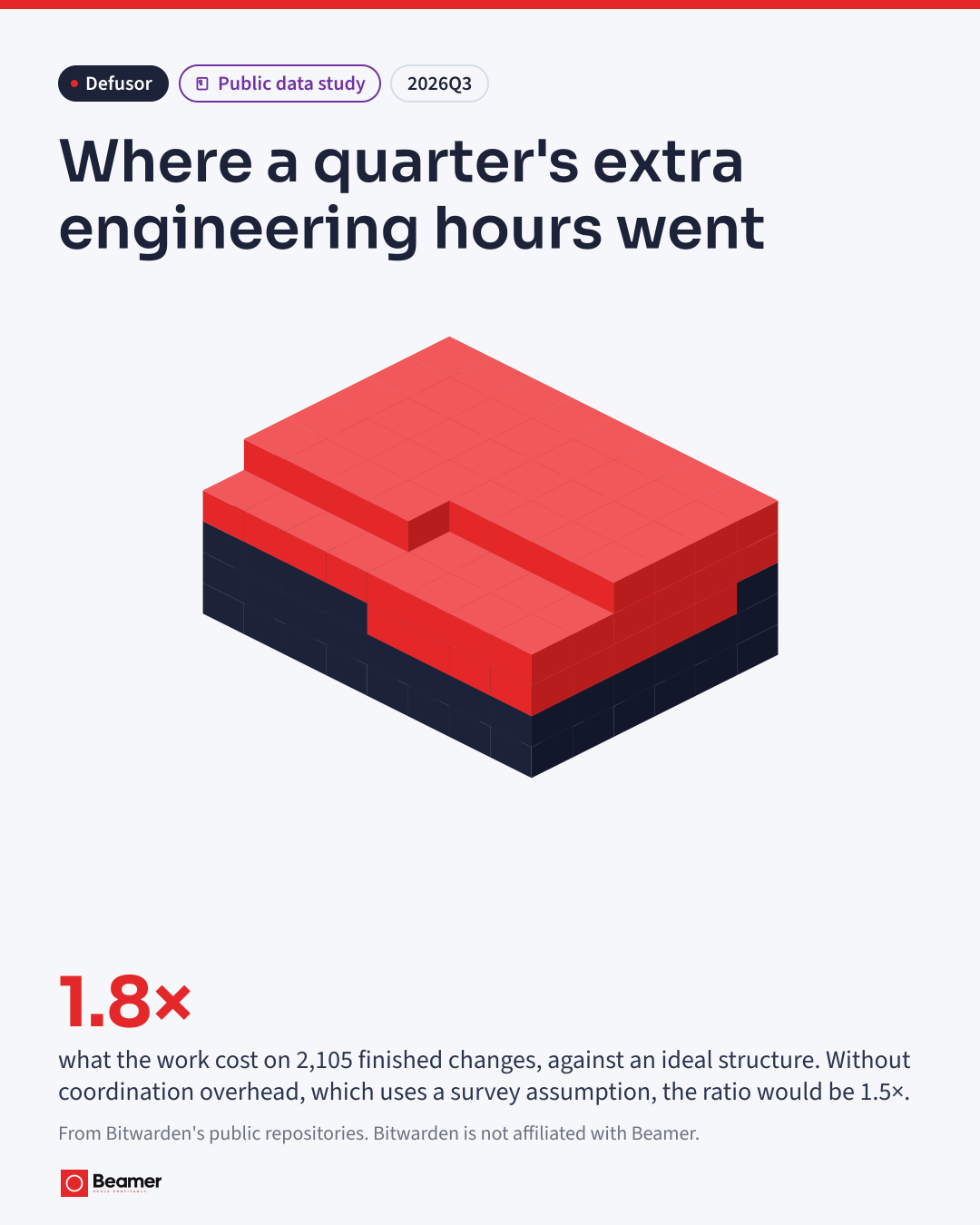
On 2,105 of Bitwarden's 2026Q3 finished changes, work cost 1.8× what it could have taken with an ideal structure. Without coordination overhead, which uses a survey assumption, the ratio would be 1.5×. Spill-over work between domains was most of sync tax.
Built from Bitwarden's public repositories. Bitwarden is not a Beamer customer and is not affiliated with Beamer.
Updated 19 Nov 2026: figures now come from Defusor's revised coordination rule. Coordination overhead is charged only for the teams a change adds beyond its own (about 3.7 engineer-hours each, from a survey of 50 engineers), so it is smaller than in the 18 Nov version.
Key figures
- what the work cost on 2,105 finished changes, against an ideal structure. Without coordination overhead, which uses a survey assumption, the ratio would be 1.5×.
- 1.8×
- what the work cost on 2,105 finished changes, against an ideal structure. Without coordination overhead, which uses a survey assumption, the ratio would be 1.5×.
- of sync tax in the quarter, 9,800 hours
- $980K
- of sync tax in the quarter, 9,800 hours
- of sync tax was spill-over work ($580K), where a change in one domain forced changes in others
- 59%
- of sync tax was spill-over work ($580K), where a change in one domain forced changes in others
- of sync tax an Account Auth Client boundary would remove, the first move
- $130K
- of sync tax an Account Auth Client boundary would remove, the first move
At a glance
Public data study- Subject
- Bitwarden, from public data. Not a Beamer customer.
- Period
- 2026Q3
- Product
- Defusor
- Repositories
- 33 public repositories, read as one product
- Finished changes
- 2,138 in the quarter
The question
When a quarter of finished engineering work costs more than it should, where do the extra hours go, and which boundary should be fixed first?
What we looked at
Defusor read Bitwarden’s 33 public repositories as one product and counted the 2,138 finished changes in the 2026Q3 quarter. 96 of the company’s people made at least one change; this is not a staff list. 94 changes by 66 people who are not regular workers (outside contributors) are left out of every figure. The groups Defusor finds are not Bitwarden’s teams.
Every amount is hours multiplied by a cost per engineering hour of $100. That rate is our assumption, because we do not know Bitwarden’s real one. The dollars scale with whatever rate you put in.
Two terms carry the study. Ideal-structure cost is an estimate of what the work could have taken with an ideal structure: each change inside one domain, shipped by one team on its own. Sync tax is the extra cost of today’s structure.
What we found
1. Today’s structure added 9,800 hours
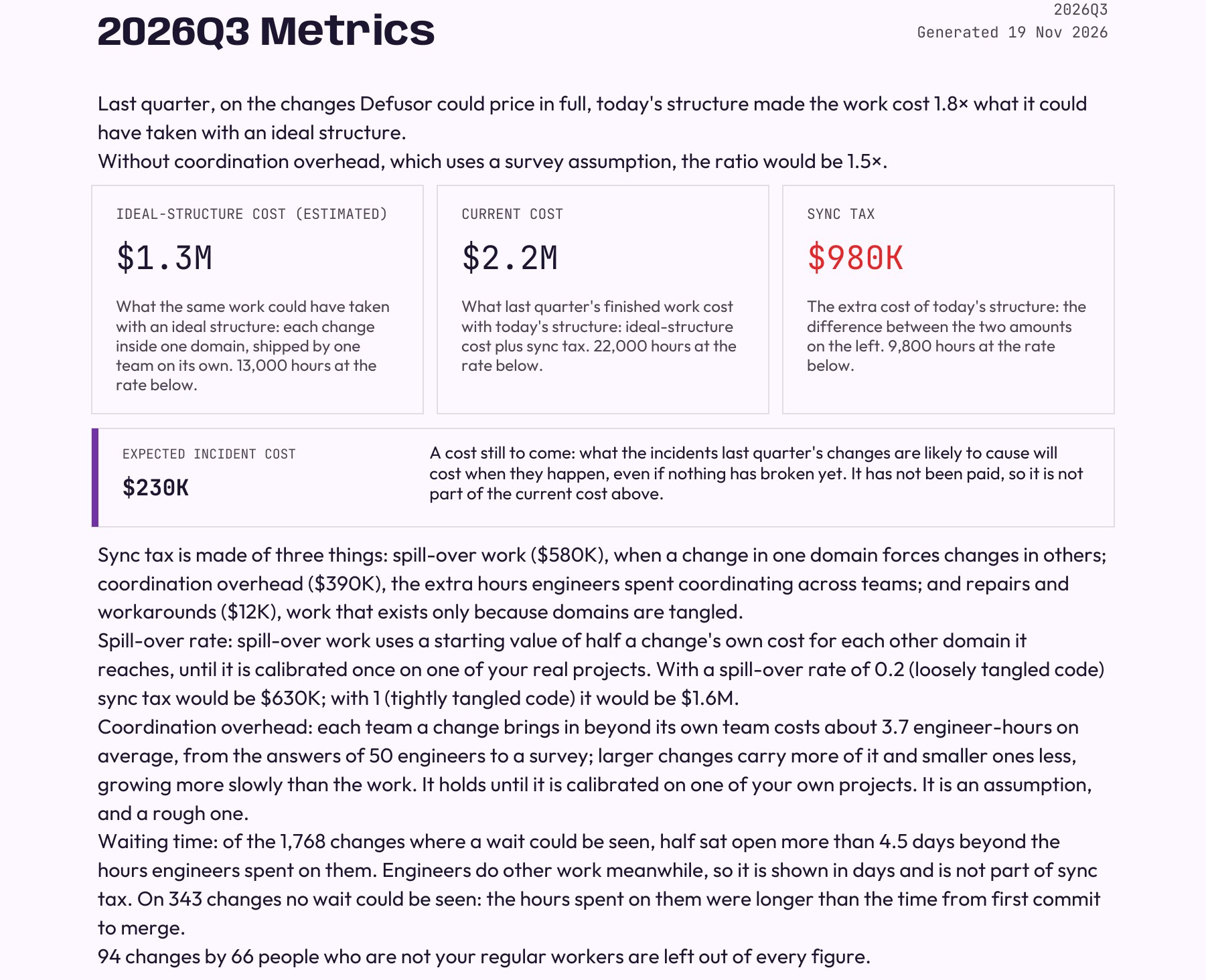
Ideal-structure cost came to 13,000 hours, $1.3M, an estimate. Sync tax added 9,800 hours, $980K. Most of it (5,800 h) is spill-over work between domains. Together that is a current cost of 22,000 hours, $2.2M. Amounts are rounded estimates, as in the report, so parts may not add up exactly.
The 1.8× is worked out on a narrower set: the 2,105 finished changes that have both an ideal-structure cost estimate and priced spill-over work and coordination overhead. On those changes, the work cost 1.8× what it could have taken with an ideal structure. Without coordination overhead, which uses a survey assumption, the ratio would be 1.5×. The 1.8× is not the ratio of the quarter totals above (22,000 hours to 13,000), because those cover all 2,138 changes.
Expected incident cost is $230K. It is a cost still to come, what the incidents these changes are likely to cause will cost when they happen, and it has not been paid, so it is not part of the current cost.
Ideal-structure cost plus sync tax make the current cost
One stacked bar. Ideal-structure cost: 13,000 h, $1.3M. Sync tax: 9,800 h, $980K. Together, the current cost: 22,000 h, $2.2M.
Amounts are rounded estimates, as in the report, so parts may not add up exactly.
Source: Defusor report, Bitwarden 2026Q3, pages 1 and 11.
Report page 1: the comparison
From the Defusor report the figures come from.
Open the full page2. Spill-over work was most of it
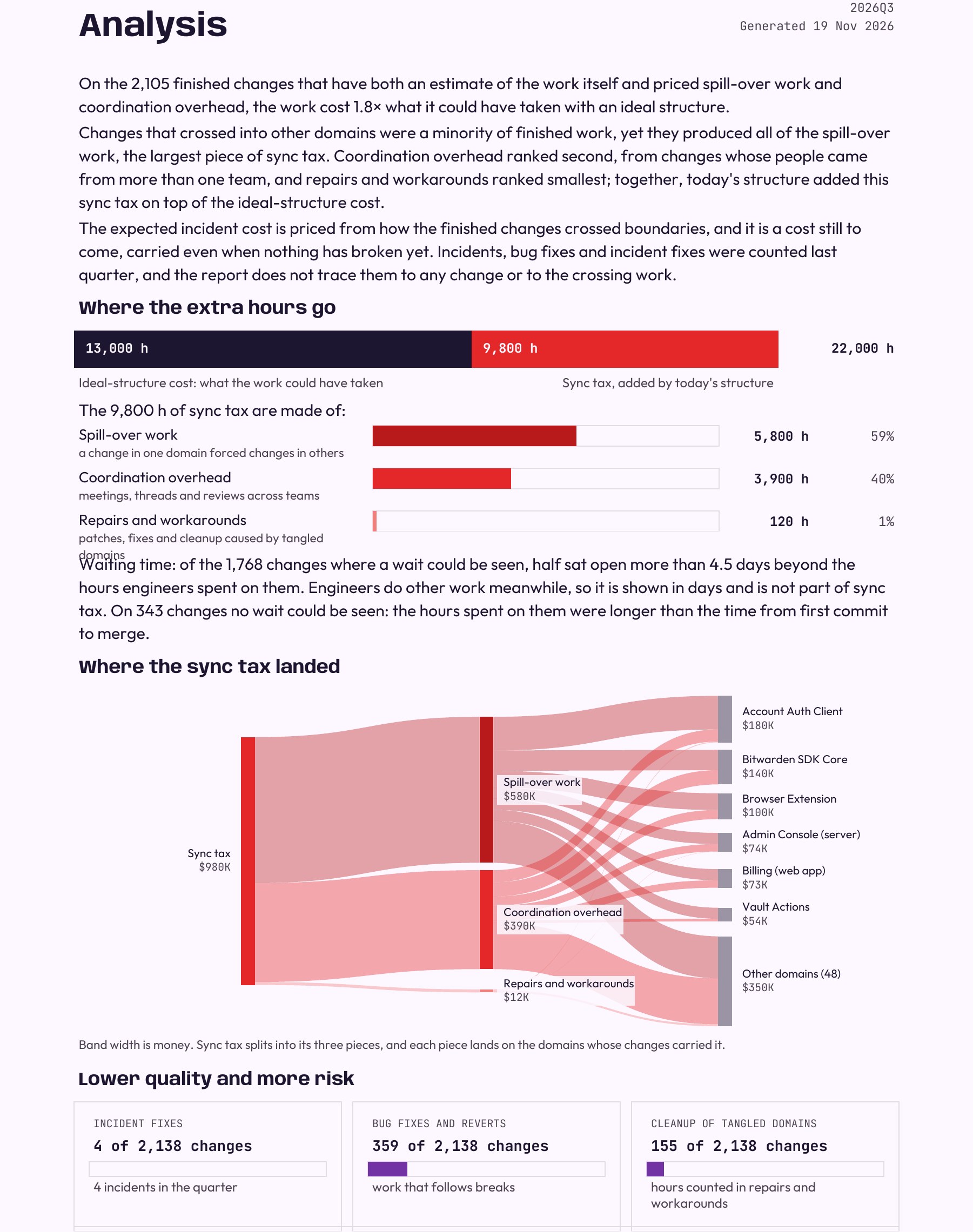
Sync tax has three pieces. Spill-over work is 5,800 hours, 59% ($580K), where a change in one domain forced changes in others. It came only from the changes that crossed into other domains, and those were a minority: 484 of the 2,138 finished changes crossed, the other 1,654 stayed inside one. It uses a starting value of half a change’s own cost for each other domain it reaches, until calibrated on one of your real projects.
Coordination overhead is the smaller part, 3,900 hours, 40% ($390K), the extra hours engineers spent coordinating across teams on changes whose people came from more than one team. It is not measured: it rests on a survey assumption. Each team a change brings in beyond its own costs about 3.7 engineer-hours on average, from a survey of 50 engineers; larger changes carry more. That holds until it is calibrated on a real project.
Repairs and workarounds is the smallest piece, 120 hours, 1% ($12K), work that exists only because domains are tangled. It includes the 4 incidents of the quarter, which took 48 hours to fix.
Waiting time is not part of sync tax. Of the 1,768 changes where a wait could be seen, half sat open more than 4.5 days beyond the hours engineers spent on them. Engineers do other work meanwhile, so it is shown in days. On 343 changes no wait could be seen.
The three pieces of sync tax (9,800 h)
Spill-over work: 5,800 h, 59%, $580K. Coordination overhead: 3,900 h, 40%, $390K. Coordination overhead rests on a survey assumption: each team a change brings in beyond its own costs about 3.7 engineer-hours on average, from a survey of 50 engineers; larger changes carry more. Repairs and workarounds: 120 h, 1%, $12K.
Each bar is the piece's share of sync tax.
Source: Defusor report, Bitwarden 2026Q3, page 12.
Report page 12: analysis
From the Defusor report the figures come from.
Open the full page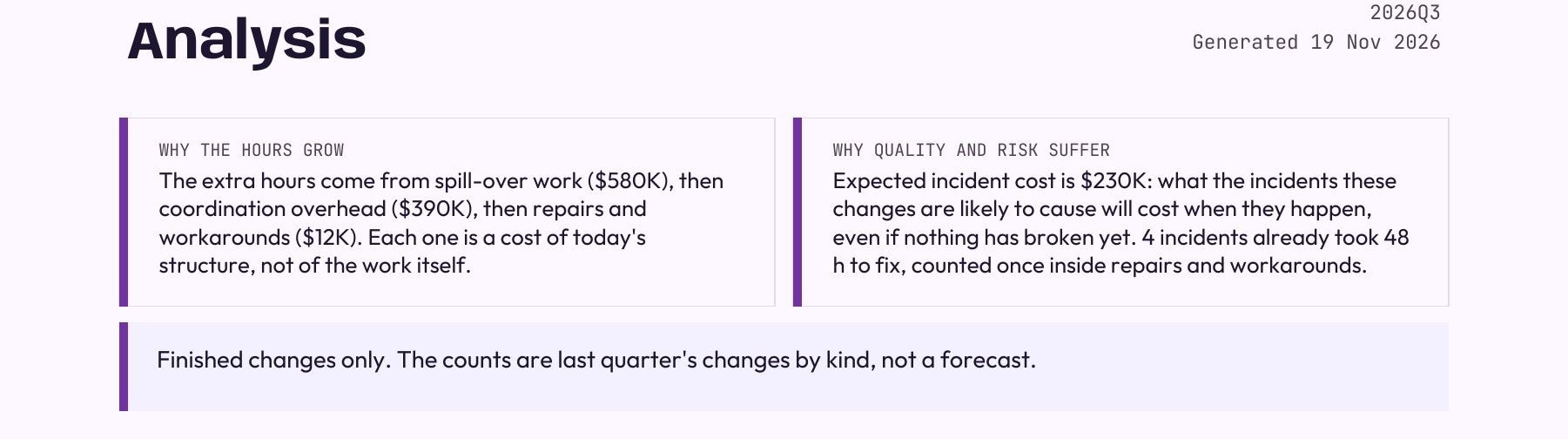
Report page 13: part of the Analysis page
From the Defusor report the figures come from.
Open the full page3. Account Auth Client carried the most
Account Auth Client carried $180K of the $980K of sync tax, on 224 finished changes. Bitwarden SDK Core carried $140K (166 changes), Browser Extension $100K (154), Admin Console (server) $74K (139), Billing (web app) $73K (144) and Vault Actions $54K (57). The other 48 domains together carried $350K. The amounts are rounded, so they may not add up exactly.
Where the $980K of sync tax landed, by domain
Account Auth Client: $180K (224 changes). Bitwarden SDK Core: $140K (166 changes). Browser Extension: $100K (154 changes). Admin Console (server): $74K (139 changes). Billing (web app): $73K (144 changes). Vault Actions: $54K (57 changes). 48 other domains: $350K.
Bar length is the domain's sync tax. In brackets, its finished changes in the quarter. Amounts are rounded, as in the report, so parts may not add up exactly.
Source: Defusor report, Bitwarden 2026Q3, pages 3 and 12.
4. The first move is an Account Auth Client boundary
Each move puts a boundary around one domain, separating it from every domain its changes reach. The report ranks the moves by the sync tax each would remove.
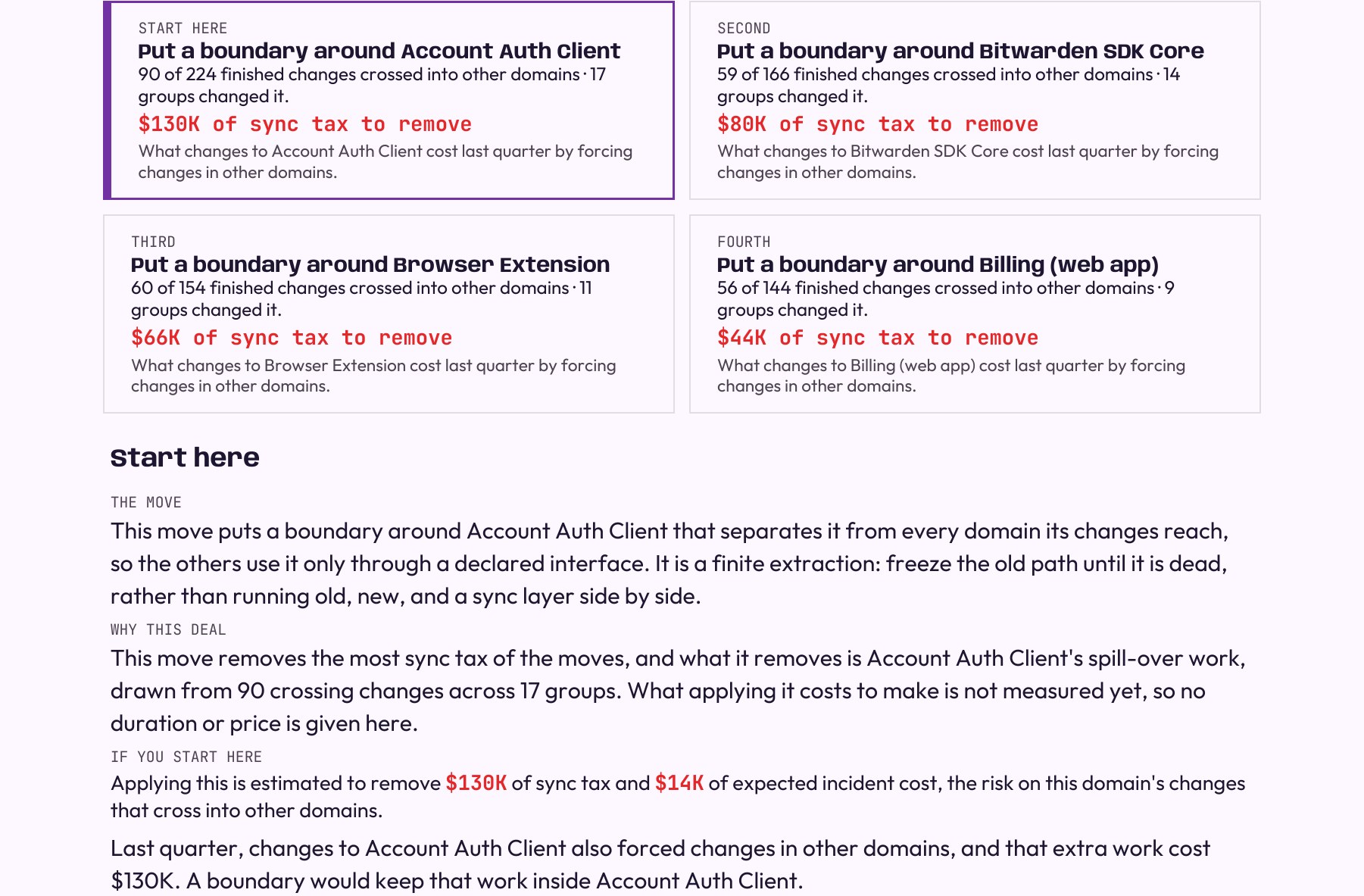
Start with Account Auth Client. 90 of its 224 finished changes crossed into other domains, and 17 groups changed it. A boundary would remove $130K of sync tax. Then, in the report’s order: Bitwarden SDK Core (59 of 166 crossed, 14 groups) would remove $80K, Browser Extension (60 of 154 crossed, 11 groups) $66K, and Billing (web app) (56 of 144 crossed, 9 groups) $44K.
What a move costs to make is not measured yet. Domain moves also do not change coordination overhead ($390K, which rests on a survey assumption): it depends on how many teams each change involves, not on where a domain’s boundary sits.
Which boundary first
A ranked list of four boundary moves, in the report’s order, by the sync tax each would remove. Start here: Account Auth Client boundary. 90 of 224 finished changes crossed into other domains, 17 groups changed it. $130K of sync tax would be removed. Second: Bitwarden SDK Core boundary. 59 of 166 finished changes crossed into other domains, 14 groups changed it. $80K of sync tax would be removed. Third: Browser Extension boundary. 60 of 154 finished changes crossed into other domains, 11 groups changed it. $66K of sync tax would be removed. Fourth: Billing (web app) boundary. 56 of 144 finished changes crossed into other domains, 9 groups changed it. $44K of sync tax would be removed.
Ranked by the sync tax each move would remove, as in the report. What a move costs to make is not measured yet. Domain moves do not change coordination overhead ($390K, priced from a survey assumption).
Source: Defusor report, Bitwarden 2026Q3, page 14.
Report page 14: part of the Recommendations page
From the Defusor report the figures come from.
Open the full pageWhat it means for a CEO
Most of the extra cost was spill-over work, from the minority of changes that crossed into other domains; its rate is a starting value until it is calibrated on a real project. Coordination overhead was the smaller part, and its $390K rests on a survey assumption. Account Auth Client carried the most sync tax.
The report puts an Account Auth Client boundary first, then Bitwarden SDK Core, Browser Extension and Billing (web app), and it counts how many of each domain’s changes crossed into other domains and how many groups changed it. Those counts come from git history, which a leadership team can check against its own product.
Limits
The rate is assumed. $100 an hour is our figure, not Bitwarden’s.
Ideal-structure cost is an estimate. It rests on 2,105 of the 2,138 finished changes.
Coordination overhead uses a survey assumption (about 3.7 engineer-hours for each team a change brings in beyond its own, from 50 engineers) until calibrated on a real project.
Spill-over work uses a starting value of half a change’s own cost for each other domain it reaches, until calibrated on one of your real projects.
What a move costs to make is not measured yet.
Expected incident cost is a cost still to come, not one already paid: $230K. The quarter had 4 incidents, which took 48 hours to fix.
Waiting time is not part of sync tax.
People who are not regular workers are left out.
Domain groupings come from how the code’s parts use each other; only the domain names come from a model reading of the code and can differ on another run.
This is one run. Amounts are rounded estimates, so parts may not add up exactly.
We used public data only and had no access to Bitwarden’s internal tools.
See it on your own code
Defusor reads your git history and returns this report for your product.
Keep going
Products
- DefusorEngineering overspend measured from your git history, in a quarterly PDF report.
- Engineering Cost ReportA free PDF on where the engineering budget goes, from 18 multiple-choice questions.
- Engineering Cost CalculatorThe Sync Tax and the Total Cost of Complexity from your own estimates, and what AI adoption does to them.
Reading
- What module coupling actually costs youSeven modules moving together, with coordination hours at zero, returns 4.50x, $27,000 per feature, and $1,008,000 a year.
- What coordination overhead costs a software companyTwenty coordination hours on a 40-hour feature add $3,000 on the coordination line. The annual figure for these inputs is $489,600.